Dragon Ball Carddass Price Guide: What Vintage Prisms Sell For (November 2026)
Vintage Dragon Ball Carddass prices from 22,878 sold listings: Hondan, Super Battle, Visual Adventure, PP Card and Limited cards, on eBay and Yahoo! Auctions.
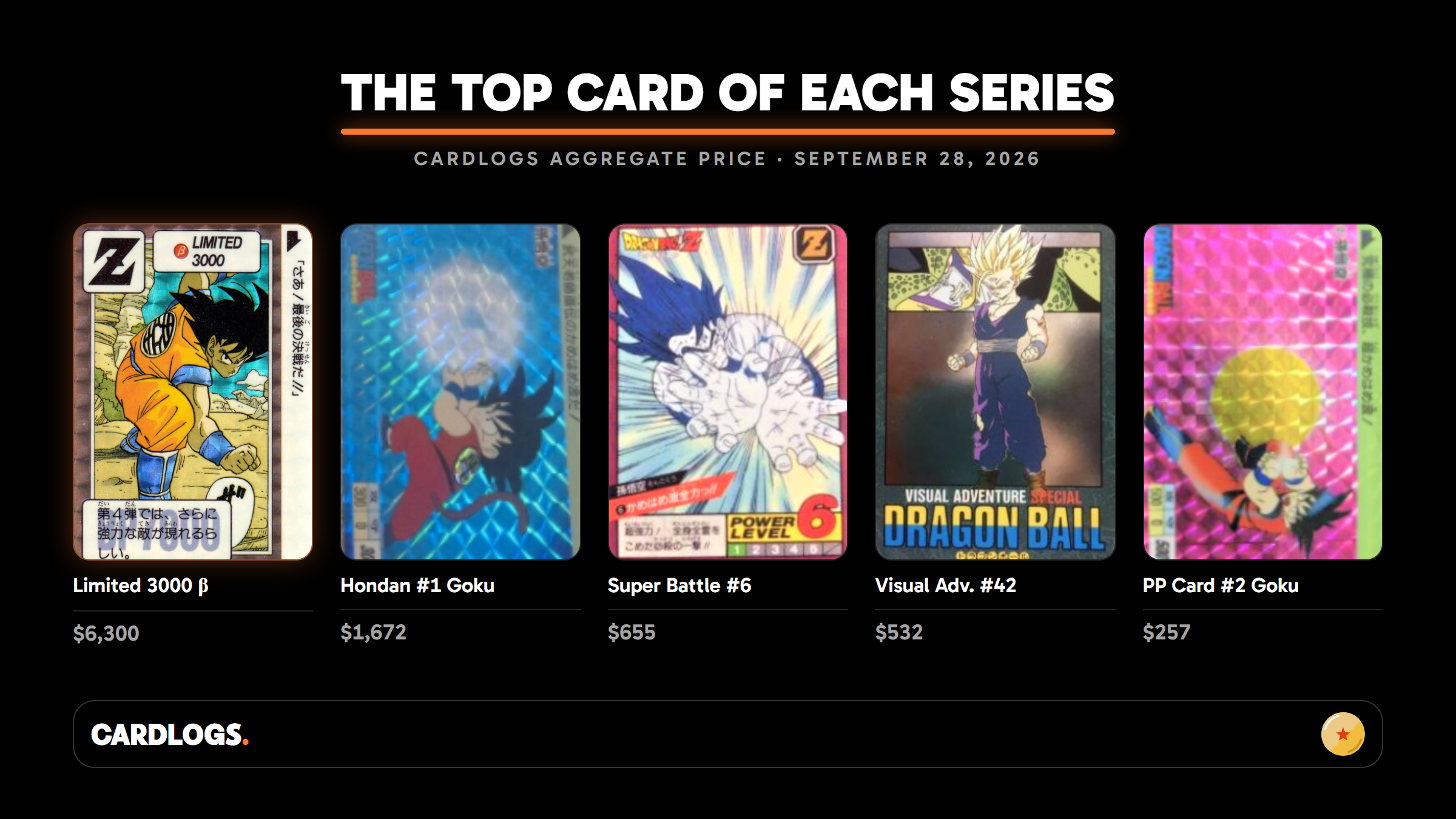
About two thirds of priced vintage Dragon Ball Carddass cards sell for $5 to $70 raw. As of November 7, 2026, the median Cardlogs Aggregate price is $13.21 for a Carddass Hondan prism, $18.95 for Super Battle, $92.18 for Visual Adventure and $10.08 for PP Card. The top of the market is far higher: the 1988 Hondan Part 1 #1 Son Goku sits at $1,564.21, and the 1989 Limited 3000 prize cards run from $848 to $4,872.
Those prices come from 22,878 matched sold listings on eBay and Yahoo! Auctions Japan, covering 1,179 cards in 108 sets from 1988 to 1998. Cardlogs prices every card from those sales, one venue at a time, and shows both venues side by side. The difference between them is large enough to change what a card is "worth", depending on where you sell it.
This guide covers the four series, the special and prize cards, what moves a prism's value, the eBay-versus-Japan gap, grading, and the French cards. For the full ranking, see the most expensive vintage Dragon Ball Carddass cards, and for October's month in review, the Dragon Ball Vintage market watch. Every card and set below links to its live page in Cardlogs' Dragon Ball Vintage tracker.
What changed since the October 22 edition?
This edition is almost all market. Of the 935 sales added to the ledger since October 22, 895 closed on or after October 22: 750 on Yahoo! Auctions Japan and 145 on eBay. Yahoo ran at about 47 Dragon Ball Carddass sales a day, close to the 50 a day of the two weeks before. Another 75 older sales were removed from the ledger.
One gap is ours. No eBay sale that closed between October 15 and October 25 is in our data: our eBay collection stopped after October 14 and resumed with sales from October 26. Those eleven days are a hole in the eBay side of this edition, not a quiet market.
Visual Adventure Part 1 #1 gave back its October rise. Five Yahoo copies sold between October 23 and November 2 for $133.55 to $797.19. Its Yahoo price fell from ¥93,500 to ¥59,999 and its Aggregate from $650.90 to $491.26, below the $551.94 of October 8. Part 3 #85 Shenron/Son Goku is now the top Visual Adventure card at $590.32, after four more raw Yahoo sales from October 31 to November 5.
Part 1 #1 Son Goku barely moved. Four more raw copies sold on Yahoo from October 23 to 31, for $530.66 to $2,224.41, and its Yahoo price held at ¥224,123. The Aggregate slipped from $1,593.20 to $1,564.21 because its eBay price ($1,988, last raw eBay sale on September 16) carries less weight as it ages, not because anything sold lower.
The prize cards did not sell, and two of them still moved by hundreds of dollars. No Limited 3000 or Limited 2000 sale, raw or graded, reached our ledger in the two weeks. The Limited 3000 β rose from $4,648.42 to $4,871.56 anyway, and the Limited 2000 X fell from $1,222.89 to $924.20. Both are the same mechanism. When a venue's newest sale is more than 90 days old, the Aggregate keeps it at a fixed minimum weight, while the other venue's sale keeps losing weight as it ages, so the blend drifts toward the old sale with nobody buying anything. The β's newest sale, about $4,325 on October 4, is still the better read.
That drift is common at the thin end of the market. Of the 343 cards whose Aggregate moved by 5% or more since October 22, 71 had no raw sale added or removed.
The eBay-versus-Yahoo gap held at 0.55x on the same 612 cards (0.546x on October 22, 0.547x now). Series medians on the same cards: Hondan $12.43 to $13.21, Super Battle $19.00 to $18.95, Visual Adventure $86.18 to $92.18, PP Card $10.00 to $10.05. Hondan and Super Battle again had about as many cards fall as rise (Hondan 61 up, 65 down). Visual Adventure is the one series leaning one way, with 25 cards up and 12 down.
How did the October 22 edition's calls hold up?
| What we said on October 22 | What happened by November 7 |
|---|---|
| Series medians rising on the same cards was churn, not a trend | Held for Hondan, Super Battle and PP Card. Visual Adventure kept rising: 25 cards up, 12 down. |
| The Limited 3000 β's $4,648.42 was a weighting effect; its $4,325 sale of October 4 is the better read | Held. No new sale, and the Aggregate drifted up another $223. |
| The eBay-versus-Yahoo gap had widened slightly, but it was not yet a market trend | Held. It stayed at 0.55x on the same cards. |
| Part 1 #1 Son Goku and Visual Adventure Part 1 #1 rose on October Yahoo sales | Split. Part 1 #1 held at $1,564.21. Visual Adventure Part 1 #1 gave all of it back, to $491.26. |
| King Piccolo #3's fall from $392.91 to $80.87 could not be trusted | Wrong about which number to distrust. |
What we got wrong: Part 1 #3 King Piccolo. We wrote that its fall from $392.91 to $80.87 rested on bad sales, and those sales are still in its ledger: a $27.77 eBay sale whose title names a different card, and two Yahoo copies described as made in 1995, which points to the Reedition reprint. But the $392.91 was the outlier. It rested on one eBay sale from September 29, while the 13 most recent Yahoo sales at the time, from June 26 to October 4, ran from $25 to $318. Four more copies sold on Yahoo between October 25 and 29, none described as a reprint, for $70.90 to $140.31, and the card now reads $109.46. It is a $100 card, not a $400 one.
What are Dragon Ball Carddass cards?
Carddass are Bandai's vending-machine cards. The name covers both the machines and the cards they dispensed, and the first Carddass came out in 1988. Dragon Ball was the line's biggest seller: Bandai had sold 2 billion Dragon Ball Carddass cards by 1998, according to figures collected on Wikipedia.
Each release ("part") mixed common regular cards with a handful of prism cards, the holofoil chase cards collectors call Carddass prisms today. Cardlogs tracks the prisms one by one and prices the regular cards as a complete 36-card set per part. Four series make up almost all of the market, plus a layer of special and prize cards:
| Series | Years | Sets in Cardlogs | Cards (prisms and specials) | Median Aggregate | Most valuable |
|---|---|---|---|---|---|
| Carddass Hondan (the main series) | from 1988 | 30 parts | 199 | $13.21 | Part 1 #1 Son Goku, $1,564.21 |
| Super Battle | from 1991 | 20 parts | 197 | $18.95 | Part 1 #6 Son Goku, $629.51 |
| Visual Adventure | from 1991 | 8 sets | 55 | $92.18 | Part 3 #85 Shenron/Son Goku, $590.32 |
| PP Card (Amada) | 1988–1997 | 35 parts | 494 | $10.08 | Part 0 #1 Son Goku, $557.01 |
| Limited, HK, V-Jump and one-off specials | 1989–1996 | 6 sets | 48 | $425.00 | Limited 3000 β, $4,871.56 |
| Reeditions, Ultimate Expo edition, Remakes | 1990–1996 | 6 sets | 63 | $32.42 | Ultimate Expo #1 Son Goku, $1,882.08 |
| French specials (Hors Série, Le Grand Combat) | 1995–1998 | 2 sets | 17 | $135.50 | Hors Série Part 3, $763.23 |
Medians cover every priced card in the series, raw, as of November 7, 2026, except the withheld Limited 3000 α. The Tokubetsudan set (10 cards, median $65.99) completes the 108.
Carddass Hondan is the original run, starting with Part 1 in 1988. Hondan prisms carry a battle power value, which is how collectors tell the two Part 1 Son Goku prisms apart (#1 reads 300, #2 reads 500). The later parts include peelable double-prism stickers.
Super Battle started in 1991 (Part 1). Its cards carry a power level on the front, which is why European sellers often list them as "Power Level" cards, and many prisms are two-layer stickers you could peel. That peel is the single biggest value question in the series (see below).
Visual Adventure (from 1991) used Akira Toriyama's manga illustrations rather than anime frames. Its Special set has laser prisms, and the 1995 Part 95 EX is the most graded Carddass set Cardlogs tracks.
PP Card was made by Amada, not Bandai. Its 35 parts carry the widest range of prism patterns (hard, bubble, line, circle, pixel, gold, laser, pearl), and Cardlogs lists each pattern as its own card.
How much are Carddass cards worth, series by series?
The typical prism is cheap and the median hides a long tail. Each venue gives its own number. Median raw prices as of November 7, 2026:
| Series | Prisms priced | Median Aggregate | Median eBay | Median Yahoo! Auctions JP | Complete 36-card regular set (median) |
|---|---|---|---|---|---|
| Carddass Hondan | 199 of 199 | $13.21 | $14.90 | $5.50 | $27.63 (30 sets) |
| Super Battle | 196 of 197 | $18.95 | $20.25 | $9.66 | $54.99 (19 sets) |
| Visual Adventure | 54 of 55 | $92.18 | $91.49 | $82.42 | $206.38 (6 sets) |
| PP Card | 397 of 494 | $10.08 | $10.00 | $6.95 | $54.00 (27 sets) |
The venue medians are computed over the cards each venue prices, so they are not always the same cards.
According to Cardlogs market data, the median vintage Dragon Ball Carddass Hondan prism sold for $13.21 raw as of November 7, 2026, while a complete run of one Hondan part's 36 regular cards had a median price of $27.63, under a dollar a card.
The first parts carry the Hondan premium. The six base prisms of Hondan Part 1 have a median of $214.05, led by #1 Son Goku at $1,564.21 and #2 Son Goku at $340.74. That median was $185.80 two weeks ago; most of the rise is the King Piccolo #3 correction above. By era, Hondan prisms have a median of $29.19 in Parts 1–5, $6.15 in Parts 6–12, $7.83 in Parts 13–20 and $13.75 in Parts 21–30. The middle years are the cheapest place to collect.
Super Battle is flat across its parts. Unpeeled part medians run from $9.91 (Part 17) to $50.14 (Part 20), with Parts 7, 3 and 19 next at $37.83, $32.59 and $32.08. Part 1's median is $23.23, and it holds the two most valuable Super Battle cards, #6 Son Goku at $629.51 and #25 Frieza at $360.02. Neither has a raw sale in our ledger since October 18. The #6 eased and the #25 rose on the same aging effect as the prize cards; the #6's October sales ran from about $254 to $2,095, the top one a mint, fully unpeeled copy.
Visual Adventure is the most expensive regular series at a $92.18 median. Its top regular-part cards are Part 3 #85 Shenron/Son Goku at $590.32 and Part 1 #1 Bulma/Krillin/Son Goku at $491.26, priced on 37 and 48 raw sales in two years across both venues. Its regular sets also cost the most: the Part 4 set of 36 regular cards is priced at $234.03 and the Part 3 set at $215.98.
PP Card is the deepest and least liquid. Of 494 PP Card rows, 397 have a price. Most of the unpriced ones are pattern variants that have not sold in two years on either venue.
What makes a Carddass prism valuable?
Five things, roughly in this order: which product it came from, whether it has been peeled, its prism pattern, its condition, and which market you sell it in.
Prize and special cards
The most valuable cards were never in the vending machines. The Limited 3000 set was a 1989 Weekly Shonen Jump lottery prize, and Limited 2000 came from a 1993 Akira Toriyama prize campaign. Their medians, as of November 7, 2026:
| Product line | Cards priced | Median Aggregate | Most valuable |
|---|---|---|---|
| Limited 3000 (1989) | 6 of 7 (α withheld) | $2,326.40 | Limited 3000 β, $4,871.56 |
| Limited 2000 (1993) | 10 of 10 | $1,041.27 | Limited 2000 VI, $1,192.02 |
| Ultimate Expo Edition (1994) | 5 of 7 | $410.20 | Son Goku #1, $1,882.08 |
| Special HK | 3 of 6 | $157.50 | HK II, $239.94 |
| Special Limited (one-offs) | 9 of 14 | $100.00 | Jump Museum '92, $1,414.99 |
| V-Jump | 5 of 6 | $75.73 | $157.77 |
| Limited 6000 (1994) | 5 of 5 | $67.97 | Limited 6000 #3, $319.00 |
Most of these prices rest on one to three sales, which the ranking article flags card by card. The Limited 2000 VI, now the top card of its set, rests on one Yahoo sale from July 8. The Limited 2000 X held that spot two weeks ago and fell to $924.20 without a sale (see above), and its only eBay sale is titled "Carte Dragon Ball Limited 2000", with no card number.
Limited 3000 and Limited 2000 are also where reproductions concentrate: eBay carries hundreds of $5 to $125 copies with identical titles and art. Cardlogs treats a raw sale of those two sets under $150 as a probable reproduction and leaves it out. One slipped past that line: a $158.71 eBay sale titled "Overseas Made" still sets the Limited 3000 α's price, so we keep that card withheld until the sale is removed.
The Reedition boxes (1995–96) reprinted the first six Hondan parts' prisms. They barely trade: only 7 of their 36 rows have a matched sale in two years. The 1994 Ultimate Expo edition is the exception: its Part 1 #1 reprint has one raw Yahoo sale, ¥298,234 on June 6, and its Aggregate of $1,882.08 sits above the original's.
Modern Bandai reissues, such as the Carddass Premium Set and Remix boxes, are a different product. Cardlogs drops any listing that says it is a reprint, a Premium Set or a Remix card, so they never enter a vintage price.
Peeled or unpeeled
Many Super Battle prisms and the Hondan double prisms of 1994–97 are two-layer stickers. Once the top layer has been peeled, the card shows a different picture and sells for much less. Cardlogs prices the two states as separate cards.
According to Cardlogs market data, across the 76 Super Battle cards priced both ways as of November 7, 2026, an unpeeled card sells for a median 2.1 times its peeled copy.
The gap is wider on the chase cards. Super Battle Part 1 #25 Frieza is $360.02 unpeeled and $71.35 peeled (5.0x), and #6 Son Goku is $629.51 against $168.35 (3.7x). On some mid-priced cards it is larger still: Part 7 #275 Son Gohan sits at $116.08 unpeeled against $12.50 peeled. Fifteen Hondan cards have both states priced, at a median 1.8x.
Japanese listings say 未剥がし (unpeeled) or 剥がし済み (peeled). English listings are less consistent, so read the photo before paying an unpeeled price.
Prism pattern (PP Card)
On PP Card the rarest patterns set the price. Median raw prices by pattern, November 7, 2026:
| PP Card pattern | Rows | Priced | Median Aggregate |
|---|---|---|---|
| Regular prism | 268 | 258 | $9.91 |
| Hard prism | 143 | 98 | $9.66 |
| Pixel prism | 18 | 10 | $75.78 |
| Bubble prism | 18 | 16 | $15.71 |
| Gold | 11 | 8 | $11.50 |
| Line prism | 24 | 4 | $6.55 |
Paired card by card, a hard prism sells for a median 1.7 times the regular prism of the same number (97 pairs). The pixel prisms are the outliers. On the ten cards priced both ways the pixel version runs a median of about 24 times the regular one: #803 Son Goku/Trunks/Vegeta is $189.33 in pixel against $6.95 regular.
Hondan Parts 12 and 16 also have a version b printing, and both have matched sales. Neither carries a reliable premium. The Part 12 #500 Son Goku version b sits at $66.32 against $104.59 for the standard print, which rose from $65.22 on six new raw sales between October 24 and November 1. The Part 16 #646 version b is $33.53 against $30.02.
Laser prisms (Visual Adventure Special)
The Visual Adventure Special set has laser prisms, a wavy holofoil, beside standard prints of the same numbers. The #42 Cell/Son Gohan laser is priced at $442.58 against $250 for the standard #42, and the #39 laser at $435.44 on seven Yahoo sales against $229.98. The laser #40 ($504.87) and #38 ($403.89) each rest on one Yahoo sale, and the #41 laser ($189.32) sits below its standard print ($229.37).
Why do Carddass cards sell for less on Yahoo! Auctions Japan than on eBay?
Because the two are different markets. Cardlogs keeps a separate price for each venue, and on almost every card the Japanese one is lower.
According to Cardlogs market data, on the 621 vintage Dragon Ball Carddass cards with at least two raw sales on each venue, the Yahoo! Auctions Japan price was a median 0.55 times the eBay price as of November 7, 2026, and Yahoo was the higher venue on 122 of them.
| Series | Cards compared | Median Yahoo ÷ eBay | Middle half of cards |
|---|---|---|---|
| All vintage Carddass | 621 | 0.55x | 0.34x–0.88x |
| Carddass Hondan | 188 | 0.51x | 0.33x–0.74x |
| Super Battle | 173 | 0.51x | 0.34x–0.84x |
| PP Card | 184 | 0.61x | 0.33x–0.99x |
| Visual Adventure | 44 | 0.72x | 0.52x–1.22x |
| Reeditions and remakes | 20 | 0.48x | 0.38x–0.68x |
The gap barely changes with price: 0.53x on cards under $50 on eBay (496 cards), 0.59x from $50 to $200 (108 cards) and 0.70x from $200 to $1,000 (15 cards).
The gap has not moved since October 22: 0.546x then and 0.547x now on the same 612 cards. The slight widening of early October, which we said was not yet a trend, did not continue. This edition's eBay side carries fewer new sales than usual because of the October 15–25 collection gap, so read the next edition before calling the gap settled.
Graded prize cards show the gap most clearly, because a slab fixes the condition. A PSA 6 Limited 3000 β sold for $8,000 on eBay on July 17, 2026, and a PSA 6 copy sold for ¥198,000 (about $1,256) on Yahoo on April 14. The Yahoo sale is three months older, but a gap that size does not come from timing.
The likeliest reason is supply. These cards were sold in Japan, most surviving copies are still there, and a large share of eBay listings ship from Japan with the seller's export costs and margin on top. For a collector the practical point is simple: a Carddass "price" means little until you know which market it came from. On every Cardlogs card page, eBay and Yahoo! Auctions JP are shown as separate rows.
The Cardlogs Aggregate price is how Cardlogs combines them. The Cardlogs Aggregate price is one blended US-dollar price per card: each marketplace's own price, weighted by how many sales back it and how recent they are, and when the two marketplaces sit more than 3x apart it keeps the eBay price alone. A card priced on Yahoo alone therefore tends to read lower than an eBay-priced card of the same real value, and a card whose two venues last sold months apart can drift with no sale at all, as the prize cards did this fortnight.
How many Dragon Ball Carddass cards are PSA graded?
Grading is rare and gem mint grades are rarer. PSA has graded 11,970 copies across the 686 vintage Dragon Ball Carddass entries Cardlogs matches, and only 334 are PSA 10 (2.8%), as of November 7, 2026.
| Series | PSA-graded copies | PSA 10 | Gem rate |
|---|---|---|---|
| Visual Adventure | 4,017 | 258 | 6.4% |
| Carddass Hondan | 3,826 | 53 | 1.4% |
| Super Battle | 1,893 | 16 | 0.8% |
| Limited, HK, V-Jump and one-off specials | 832 | 1 | 0.1% |
| PP Card | 764 | 5 | 0.7% |
| Reeditions, Ultimate Expo, Remakes | 381 | 1 | 0.3% |
According to Cardlogs population data, only 334 of the 11,970 PSA-graded vintage Dragon Ball Carddass cards are PSA 10 as of November 7, 2026, a gem rate of 2.8%, and the 1988 Part 1 #1 Son Goku has one PSA 10 among 235 graded copies.
The populations grew by 100 copies in two weeks and the PSA 10 count did not move. The most graded card is Visual Adventure Part 95 EX #258 Son Goku & Majin Buu, with 381 PSA copies and 44 PSA 10s. Visual Adventure has the best gem rate, and most of it comes from one set: Part 95 EX holds 159 of the series' 258 PSA 10s. The Hondan double prisms of 1994–97 have no population in Cardlogs: PSA labels peeled and unpeeled copies the same way, so a count would mix two different cards.
Low populations make PSA 10 sales large multiples of the raw price. Two examples from the sale ledger:
| Card | PSA 10 sale | Raw Aggregate | PSA 10 population |
|---|---|---|---|
| Visual Adventure Part 2 #47 Son Goku/Vegeta | $1,100 (Jan 20, 2026) and $810 (Jul 23, 2026) | $34.35 | 3 of 71 graded |
| Hondan Part 15 #614 Goku & Gohan | $1,000 (Feb 28, 2025) | $20.89 | 2 of 83 graded |
The ledger holds 1,839 graded sales at a known grade: 1,543 PSA, 161 BGS, 132 CGC, 2 HGA and 1 SGC. BGS Gold Label copies of Visual Adventure sell well in Japan: a BGS 9.5 Part 4 #127 Son Goku sold for ¥1,101,000 (about $6,986) on Yahoo on August 29, 2026.
What are French Carddass cards worth?
The French special cards have their own market, almost entirely on eBay in Europe, and none of them has a Yahoo sale. The five most valuable as of November 7, 2026:
| Card | Set | Aggregate (eBay) | eBay sales in two years |
|---|---|---|---|
| Hors Série Part 3 | Le Grand Combat Spéciales | $763.23 | 3 (newest Oct 31, 2025) |
| Spéciale Flash Part 8 | Le Grand Combat Spéciales | $366.48 | 4 (newest Feb 22, 2026) |
| Hors Série Part 9 | Le Grand Combat Spéciales | $259.31 | 5 (newest May 9, 2026) |
| Songoku & ses amis (Hors Série Part 22) | Carddass Hors Série | $222.49 | 3 (newest Dec 22, 2025) |
| Spéciale Flash Part 7 | Le Grand Combat Spéciales | $195.65 | 5 (newest Mar 28, 2026) |
None of the five has sold since March 28, 2026, so the table is unchanged since October 8. One card is left out on purpose. Hors Série Part 8 went from $111.05 to $279.08 on a single November 1 eBay sale titled "Hors-série 1998", which does not say which part it is. On that sale it would rank third, so we wait for a second one.
Le Grand Combat was the French edition of Super Battle, and its 13 special cards are priced from $19.02 to $763.23. The Hors Série Part 22 card's price rests on the newest of its three sales, $222.49 in December 2025; the other two were $1,527 (August 2025) and $737.55 (May 2025). It also exists peeled, at $56.59, so the peel rule applies to the French cards too. The better-traded French cards are cheaper: Spéciale Flash Part 6 sits at $54.44 on 13 sales and Spéciale Flash Part 4 at $29.21 on 15.
The regular French-printed cards are not priced as separate rows yet, and listings that say they are French editions are kept out of the Japanese cards' prices. French collectors searching a "cote carddass" can use the Japanese price of the same card number as a reference, not as the French price.
Where this data comes from
Cardlogs prices every vintage Dragon Ball Carddass card from matched sold listings on two marketplaces: eBay completed sales (three years deep) and Yahoo! Auctions Japan closed auctions. The card list comes from dbzprice.com and the card names and population counts from gemrate.com. Each sale is matched to one exact card and printing (part, number, peeled or unpeeled, prism pattern) from its title, and expensive or ambiguous matches are checked against the listing photo.
As of November 7, 2026, the ledger holds 22,878 matched sales (14,550 eBay, 8,328 Yahoo; 20,879 raw, 1,839 graded at a known grade and 160 slabs whose grade the listing did not state) across 1,179 cards in 108 sets, and 1,025 cards carry a price, up from 1,020 on October 22. eBay sales that closed between October 15 and 25, 2026 are missing, a collection gap on our side. Each venue's price is a recency-weighted median of its newest 10 raw sales within two years. Yahoo prices are kept in yen and converted at ¥158.33 per US dollar, the ECB reference rate of November 6, 2026; individual Yahoo sales quoted in dollars were converted when Cardlogs recorded them. The Cardlogs Aggregate price blends the two venue prices as described above.
Complete-set rows price a full run of one part's 36 regular cards. Graded sales are shown individually and never feed a raw price. Medians in this guide cover every priced card in the group, and the "Yahoo ÷ eBay" figures cover only cards with at least two raw sales on each venue.
Carddass prices move one sale at a time. Track every card in this guide, with the eBay and Yahoo! Auctions JP prices shown separately, the full sale history and PSA population, at cardlogs.com/dragonball-vintage/home, or in the Cardlogs iOS and Android apps. Looking for the modern game instead? See the most expensive Dragon Ball Fusion World cards.
Frequently asked questions
How much are vintage Dragon Ball Carddass cards worth?
About two thirds of priced vintage Carddass cards sell for $5 to $70 raw. As of November 7, 2026, the median Cardlogs Aggregate price is $13.21 for a Carddass Hondan prism, $18.95 for a Super Battle prism, $92.18 for a Visual Adventure prism and $10.08 for a PP Card prism. Early Hondan cards, lasers and the Limited prize cards sell for hundreds to thousands of dollars.
What is the most valuable Dragon Ball Carddass card?
As of November 7, 2026, the highest Cardlogs Aggregate price is the 1989 Limited 3000 β at $4,871.56, priced on both eBay ($6,300, sold July 14) and Yahoo! Auctions Japan (about $3,726). Its newest sale, about $4,325 on October 4, is the better read. The most valuable regular-series card is the 1988 Hondan Part 1 #1 Son Goku at $1,564.21, backed by 70 raw sales, with one PSA 10 among 235 graded copies.
Is a peeled Super Battle card worth less than an unpeeled one?
Yes. According to Cardlogs, across 76 Super Battle cards priced both ways as of November 7, 2026, the unpeeled card sells for a median 2.1 times its peeled copy. The gap is wider on some chase cards: Super Battle Part 1 #25 Frieza is $360.02 unpeeled and $71.35 peeled.
Why are Carddass cards cheaper on Yahoo! Auctions Japan than on eBay?
According to Cardlogs, on 621 vintage Carddass cards with at least two raw sales on each venue, the Yahoo! Auctions Japan price is a median 0.55 times the eBay price as of November 7, 2026, and Yahoo is higher on only 122 of them. Japan is where the cards were sold, so supply is deepest there.
What are French Carddass cards worth (Hors Série, Le Grand Combat)?
The French special cards trade on eBay in Europe, not on Yahoo. As of November 7, 2026, Cardlogs prices the 13 Le Grand Combat Spéciales from $19.02 to $763.23, led by Hors Série Part 3 at $763.23 on three sales, and the Carddass Hors Série Part 22 'Songoku & ses amis' at $222.49. Regular French-printed cards are not priced separately yet.