Riftbound Origins Wave 1 vs Wave 2: How to Spot a First-Print Box
Three ways to tell a wave 1 (first print) Riftbound Origins booster box from a wave 2 reprint: bold print, CE/UKCA marks, and the importer block.
A wave 1 (first print) Riftbound Origins booster box is identifiable in about five seconds without opening anything: its back-panel legal block has no importer addresses, its riot.com/riftbound line is bold, and CE and UKCA marks sit beside the barcode on the bottom. Wave 2 reprints invert all three. Sealed Origins traded at $313.44 on July 29, 2026.
Riftbound — the League of Legends TCG by Riot Games — shipped its debut set Origins on October 31, 2025, ran out, and got reprinted. Collectors call the runs wave 1 and wave 2, and the market now pays for the difference. Here is how to read a box.
What is a wave 1 Riftbound Origins box?
Wave 1 is the first print run of Origins — the boxes that were on shelves for the October 31, 2025 launch, before the set sold out. Wave 2 is the reprint that followed.
The vocabulary is the collector market's, not Riot's. Riot's own post-launch note on November 10, 2025 said only that it "missed the mark on demand", promised "more Riftbound: Origins products arriving to local game stores between now and the end of the year", and referred to "potential additional reprints". It never used the words wave or print run. So treat the two-run split as documented by the boxes themselves and by the sellers pricing them, not as an official Riot product distinction.
How do you tell a wave 1 Origins box from a wave 2?
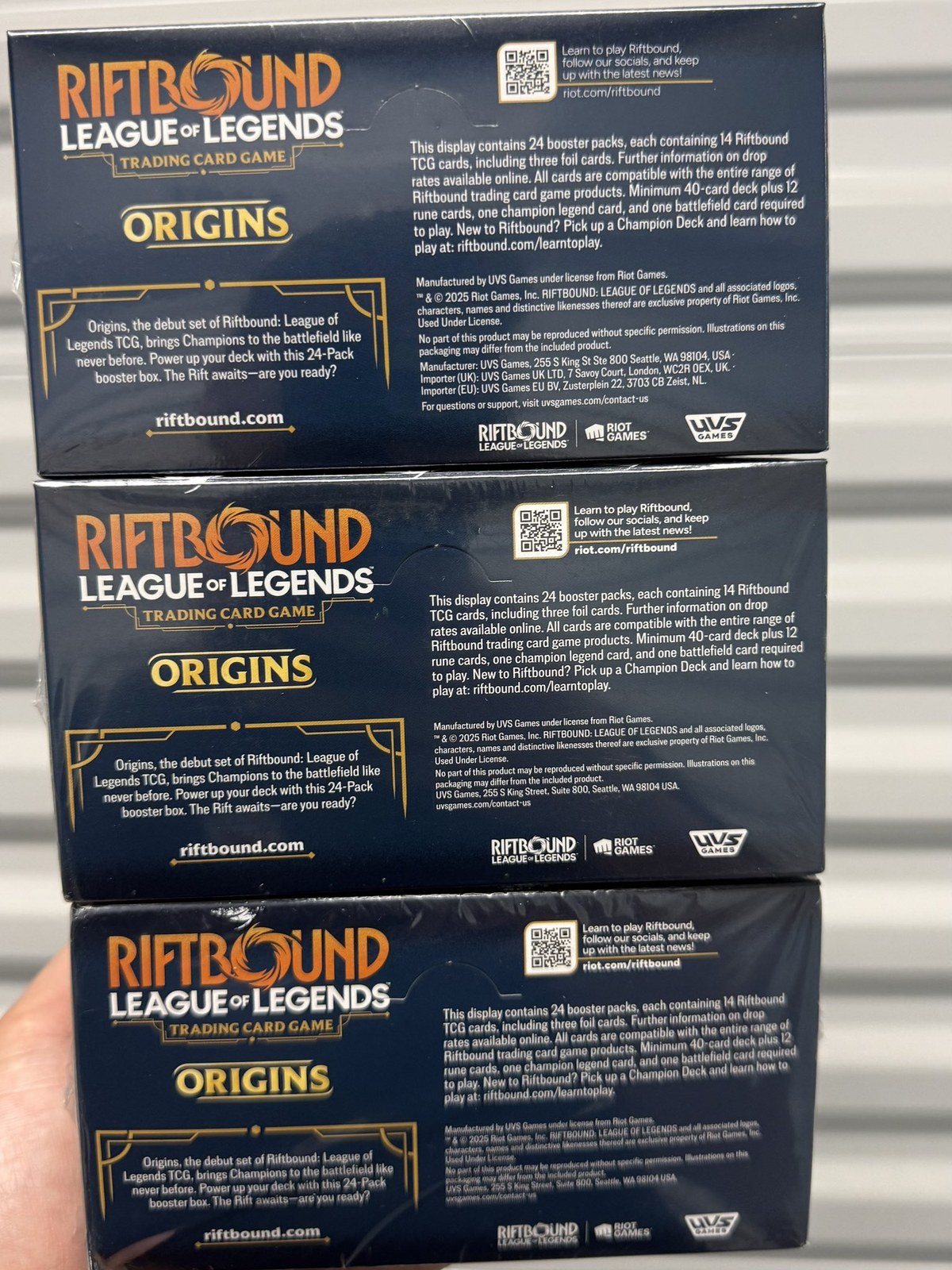
Three differences, all on the outside of a sealed box. Every one of them is visible in the photos above and below.
| Where to look | Wave 1 (first print) | Wave 2 (reprint) |
|---|---|---|
| Back panel, legal block | Ends on one address line: "UVS Games, 255 S King Street, Suite 800, Seattle, WA 98104 USA" | Adds three lines: "Manufacturer:", "Importer (UK): … 7 Savoy Court, London", "Importer (EU): … Zusterplein 22, Zeist, NL" |
| Back panel, under the QR code | riot.com/riftbound in bold |
Same URL in regular weight |
| Bottom panel, beside the barcode | CE and UKCA marks present; product code and paragraph in heavy type | No CE or UKCA marks; code and paragraph in light type |
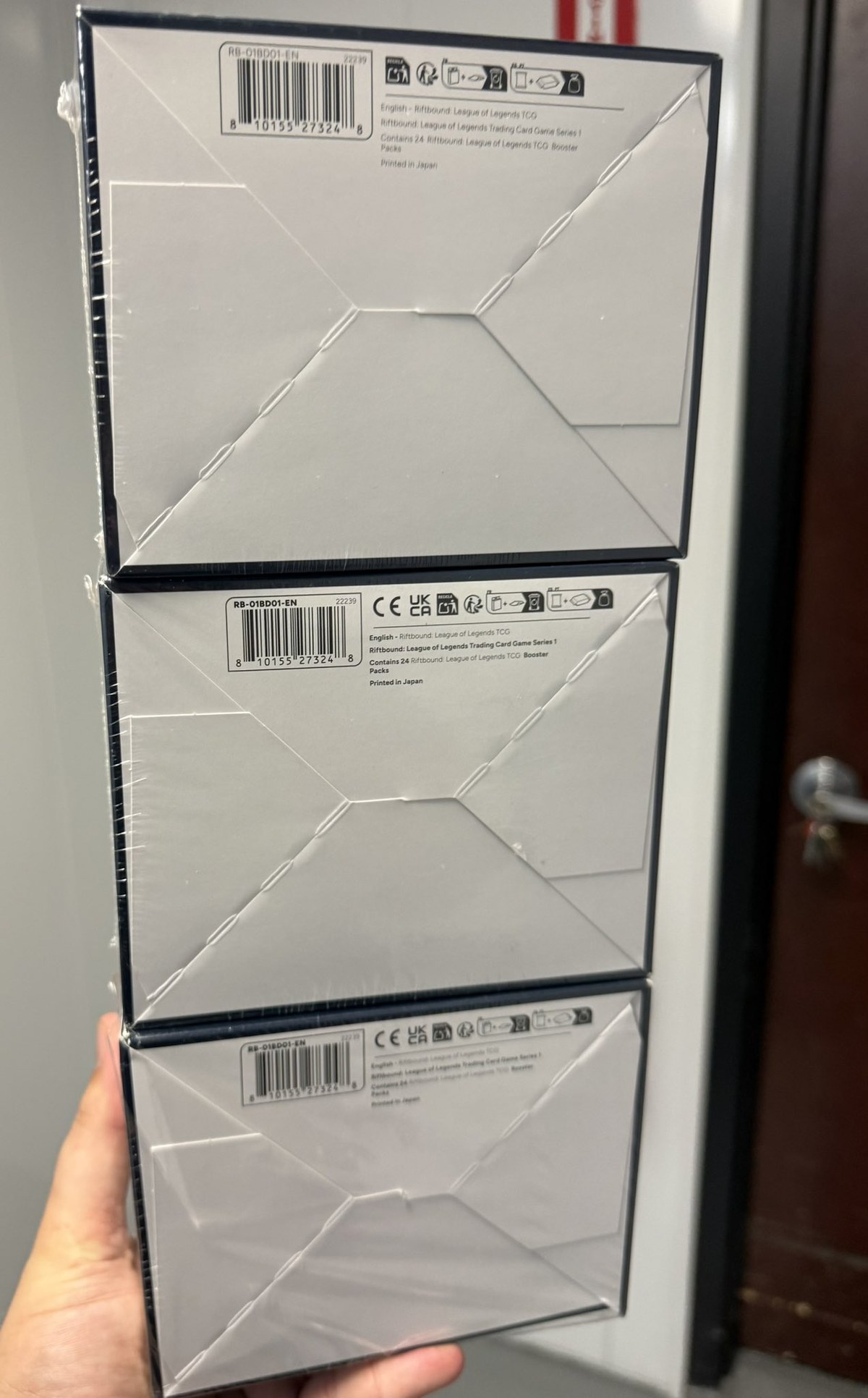
Note the direction of that third row, because it is counterintuitive: the reprint adds UK and EU importer addresses to the back while dropping the CE and UKCA marks from the bottom. Both changes are real and both appear on the same boxes; we have no confirmed explanation for the pairing, and neither Riot nor UVS Games has published one.
Which tell should you trust?
The legal block, and it isn't close. Presence or absence of three labelled address lines is a yes-or-no reading that survives a bad photo, a phone camera and a plastic wrap glare.
Print weight is the tell most people quote and the weakest one to act on. Bold-versus-regular is a judgement call across two boxes side by side — which is exactly the comparison you don't have when you're looking at one listing photo of one box. The CE and UKCA marks sit in between: binary like the address block, but small, low-contrast and often cropped out of a seller's shot.
Practical order when buying: check the back-panel address block first, confirm with the CE and UKCA marks, and use print weight only as a tiebreaker. If a listing shows neither panel, the box is unverified regardless of what the title claims.
What is identical on both print runs?
The parts a price feed can see. Both runs carry the same product code RB-01BD01-EN, the same UPC 8 10155 27324 8, the same "Printed in Japan" line, the same ™ & © 2025 Riot Games notice, and the same stated contents — 24 packs of 14 cards, three foils per pack.
That single shared barcode is the whole reason this article needs to exist. According to Cardlogs market data, an Origins booster display traded at $313.44 on TCGplayer as of July 29, 2026, up 22% in seven days and 68% in thirty — and that figure blends both print runs, because wave 1 and wave 2 resolve to one UPC and one product listing on every marketplace we track. No price feed anywhere separates them. The premium exists only in listing titles, where sellers type "1st Print" or "Wave 1" by hand.
How much is the first-print premium?
Reported, not measured — and we are going to be precise about which is which.
| Measure | Value | As of |
|---|---|---|
| Origins booster display, TCGplayer market | $313.44 | July 29, 2026 |
| TCGplayer lowest listings | $294.00 | July 29, 2026 |
| Cardmarket market price | €168 (~$191) | July 29, 2026 |
| Origins case (TCGplayer) | $2,030.13, +71% in 30 days | July 29, 2026 |
| Wave 1 box, reported eBay asking range | above $500 | July 29, 2026 |
The $500+ figure comes from the collector who published the photos above, describing his own eBay observations. It is a credible report and it is not a Cardlogs number: our sealed feed covers TCGplayer and Cardmarket, neither of which distinguishes print runs, so we cannot corroborate a print-run premium from market data and will not present one as measured.
What our data does show is that the underlying box has run hard regardless of print run. Origins sealed was $257.42 on July 24, 2026 and $313.44 on July 29 — a 22% move in five days, 68% over thirty — with a case up 71% in the same month. Any premium a first-print box commands is stacked on top of that move, not instead of it.
One caution on the venue spread: at the day's ECB rate the €168 Cardmarket price converts to about $191, some 39% below the TCGplayer figure. That fails the cross-venue check Cardlogs applies before letting a single marketplace carry a headline price, so treat sealed Origins as a $191–$313 range by region rather than one number, and read any eBay premium against your own market.
Does wave 1 contain better cards?
Nothing confirms that it does. The differences documented on these boxes are packaging and regulatory text; the stated contents are identical, and Riot has published no pull-rate difference between print runs. The first-print premium is a provenance premium, in the same family as a first-edition print line on a Pokémon box.
That matters for what you do with the box. According to Cardlogs market data, an Origins box carries a Cardlogs Box EV of $245.50 against its $313.44 TCGplayer price as of July 29, 2026 — about 78 cents of expected pull value per dollar. Cardlogs Box EV is the expected market value of the cards inside one sealed box, computed nightly from per-box pull odds and current single prices. Opening a box is already below water at today's sealed prices; opening a verified first print means paying a collectors' premium for the wrapper and then destroying it. Full set-by-set numbers are in our Riftbound booster box EV breakdown.
Where this data comes from
Cardlogs aggregates prices nightly from TCGplayer, Cardmarket and eBay sold listings (via PriceCharting) across more than 1,000 tracked Riftbound cards, plus PSA and BGS population data, and recomputes Cardlogs Box EV per set from community-derived per-box pull odds (Riot publishes pack structure, not per-rarity percentages) and those same single prices. Sealed and case prices in this article are from the July 29, 2026 snapshot; the euro conversion uses that day's ECB reference rate. The print-run differences are read from photographs of three boxes published July 29, 2026 and match the differences independently documented by other collectors; the wave 1 eBay range is a third-party report, labelled as such above.
Sealed Origins is one of the fastest-moving products in Riftbound right now, and the box you're being quoted may have repriced twice since this page was written. Live prices for the Origins set, its sealed products and the chase singles like Ahri - Nine-Tailed Fox are on the Riftbound hub — free on web, iOS and Android. For why a single marketplace price is never enough on a product like this, see how Cardlogs tracks TCG prices. Bring the box photos; we'll handle the prices.
Frequently asked questions
How do I tell if my Riftbound Origins box is wave 1?
Read the legal block on the back panel. A wave 1 box ends with a single address line — UVS Games, 255 S King Street, Suite 800, Seattle, WA 98104 USA. A wave 2 box adds three lines labelled Manufacturer, Importer (UK) and Importer (EU). Wave 1 also prints riot.com/riftbound in bold and carries CE and UKCA marks beside the barcode.
Are wave 1 Riftbound Origins boxes worth more?
Yes, but the premium is not measurable from market data. Sealed Origins boxes traded at $313.44 on TCGplayer as of July 29, 2026, a figure that blends both print runs because the two share one UPC. First-print boxes are listed separately on eBay at reported prices above $500, which is a listing-title premium rather than a tracked market price.
Do wave 1 and wave 2 Origins boxes contain different cards?
There is no confirmed difference in contents. Every documented difference is on the outside of the box — print weight, regulatory marks and importer text. Both boxes state 24 packs of 14 cards including three foils, both are printed in Japan, and Riot has published no pull-rate difference between print runs.
Why are there two print runs of Riftbound Origins?
Riot acknowledged on November 10, 2025 that it had underestimated demand, promising more Origins product to local game stores through the end of the year plus potential additional reprints. The wave 1 and wave 2 labels are collector vocabulary for the print runs that followed, not official Riot terminology.
What is a Riftbound Origins booster box worth?
It depends heavily on the region. As of July 29, 2026 an Origins booster display was $313.44 on TCGplayer with a $294.00 floor, while the Cardmarket price of €168 converts to about $191 at the day's ECB rate — a 39% gap between venues, so quote a range rather than one number.