The Most Expensive Palworld Cards (August 2026) — Sold-Based Market Data
The most expensive Palworld TCG card is the gold Soul ESOUL-002 at $1,395 sold-based. The full top 10, every tier priced — and a correction to a finding we published six days ago.
The most expensive Palworld card is the English gold Soul ESOUL-002 — the gold Cattiva Soul — at $1,395 sold-based as of August 31, 2026, a month after the game launched. Behind it sit a new $699 entrant, the set's four SSPs, and two $450 exclusives from opposite ends of the product line. This board was the first sold-based price list published for the Palworld TCG. This edition does two things: it reports the first real movement at the top in three weeks, and it withdraws a finding we published on August 25.
Cardlogs began tracking Palworld TCG prices on August 12, 2026 — now 265 English-print cards across the Dawn of Palpagos booster, both trial decks and the promos, one of the first trackers anywhere to cover the game.
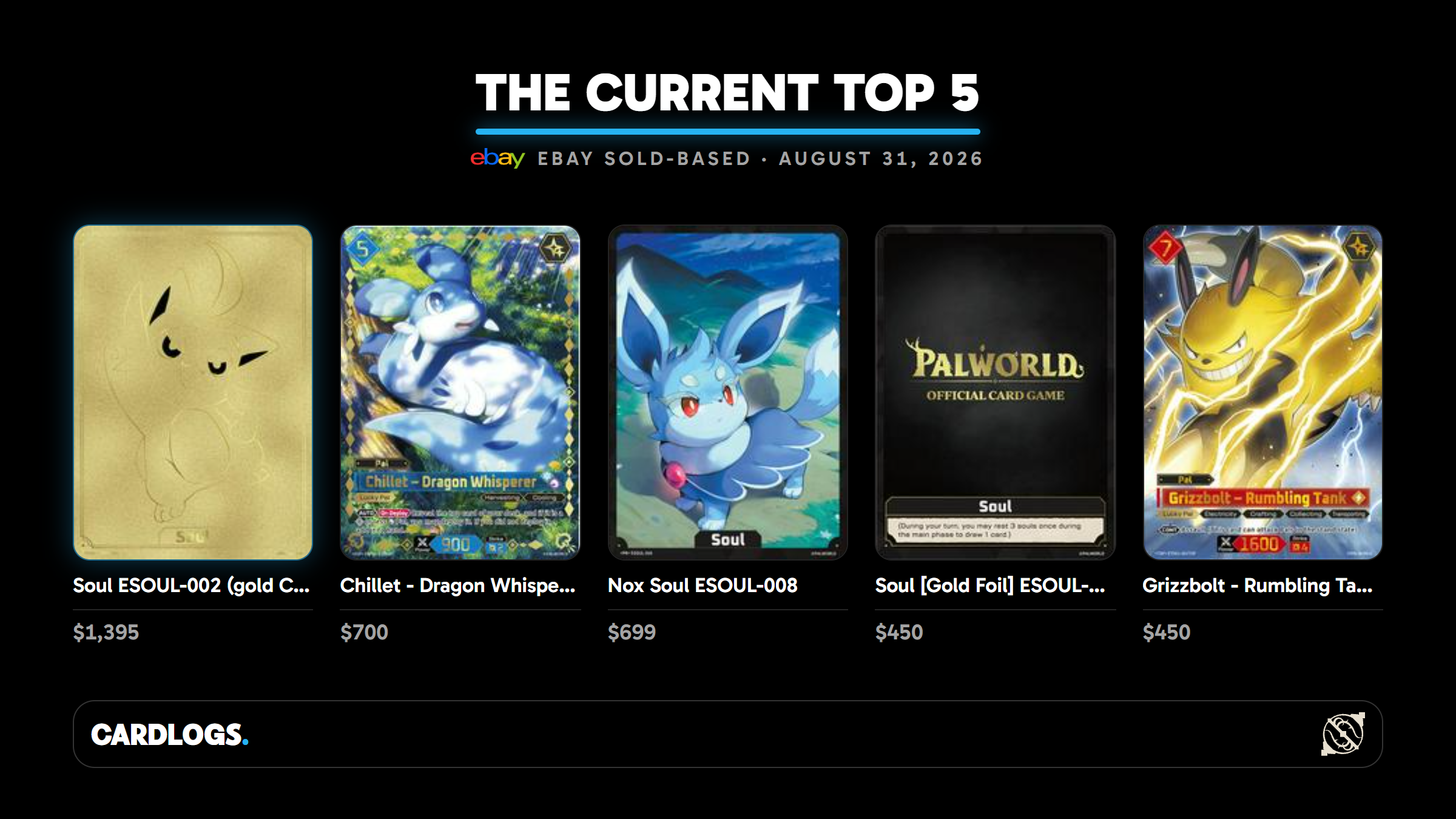
The 10 most expensive Palworld cards right now
Sold-based prices as of August 31, 2026, with the change since the August 25 board. English prints (E-prefixed collector numbers) only — see the note on Japanese cards below.
| # | Card | Number | Tier | Product | Price | vs Aug 25 |
|---|---|---|---|---|---|---|
| 1 | Soul (gold Cattiva) | ESOUL-002 | gold Soul | Booster insert | $1,395.00 | +7.3% |
| 2 | Chillet – Dragon Whisperer | EBP01-025SSP | SSP | Booster | $699.99 | +3.7% |
| 3 | Nox Soul | ESOUL-008 | gold Soul | Promo | $699.00 | new |
| 4 | Soul (gold foil) | ESOUL-000 | gold Soul | Promo | $450.00 | — |
| 5 | Grizzbolt – Rumbling Tank | ETD01-001TSP | TSP | Trial deck | $450.00 | — |
| 6 | Astegon – Aegis Wyvern of Death | ETD02-012TSP | TSP | Trial deck | $400.00 | +33.8% |
| 7 | Jormuntide Ignis – Savage Lava Dragon | EBP01-001SSP | SSP | Booster | $400.00 | — |
| 8 | Lyleen – Blessing of the Goddess | EBP01-049SSP | SSP | Booster | $374.98 | — |
| 9 | Elphidran Aqua – Gentle Ripples | ETD01-012TSP | TSP | Trial deck | $350.00 | +7.7% |
| 10 | Helzephyr – Wings of the Moonless Night | EBP01-073SSP | SSP | Booster | $250.00 | — |
According to Cardlogs market data, the most expensive Palworld TCG card is the English gold Soul ESOUL-002 at $1,395 sold-based as of August 31, 2026, up 7.3% in six days after three consecutive boards at exactly $1,300.
Two things changed at the top. The first Soul card to enter the board since launch, Nox Soul ESOUL-008, recorded its first sold price at $699.00 and went straight to third — it is the fourth of nine tracked Soul cards to ever trade. And Astegon ETD02-012TSP rose 33.8%, $298.97 to $400.00, the largest genuine move in the top 20 and the third trial-deck exclusive to reach the $400 mark.
Below the top ten, though, nothing has changed. Of the 200 cards priced on both dates, 62 fell, 34 rose and 104 did not move at all, for a mean change of −1.26% and a median of exactly 0.0%. The top 20's median move is also 0.0%, with 9 of 20 unchanged to the cent. That is the fifth straight board with the same shape: a small negative mean, a zero median, and half the market not trading at all.
Correction: the Ribbuny "collapsed premium" was a data artifact
The August 25 edition of this article reported that the textured TSR print of Ribbuny – Little Princess had lost its premium over its plain base print, 1.48× to 1.03× in six days. We are withdrawing that finding. It was a pricing error on the base print, not a market event.
Here is what we can now show. The base print ETD01-024 carries a sold-based price of $142.50 and zero recorded sales. Its price is not a median of completed listings, because there are no completed listings — it comes from PriceCharting's aggregate figure for the product, which we fall back to when a card has no sale history. The textured TSR beside it carries $147.50 off eight real sale rows.
We caught it by auditing the whole board rather than the one card. Across the 74 Palworld base/parallel pairs where both prints are priced, the parallel's premium over its base ranges from 1.67× to 400×. Exactly one pair sits below 1.15× — Ribbuny, at 1.04×. There is no cluster of near-parity pairs for it to belong to.
And the second-lowest pair on the August 25 board has since resolved itself, which is the proof of mechanism:
| Mossanda – Guard Captain (ETD02-001) | Aug 25 | Aug 31 | Sale rows |
|---|---|---|---|
| TSP (trial-deck parallel) | $150.00 | $150.00 | 22 |
| base print | $120.00 | $5.00 | 0 → 1 |
| TSP premium | 1.25× | 30.00× |
The base Mossanda sat at $120 on an aggregate with no sales behind it. The moment its first real completed listing arrived, the price fell 95.8% to $5.00 and the pair snapped into line with the other 73. We expect the base Ribbuny to do the same when it first trades, and we are stating that in advance so the next edition can be checked against it.
The wider audit is the reassuring part: of the 214 priced English Palworld cards, 213 rest on at least one recorded sale, and 170 of them on a full 30-sale window. Exactly one — the base Ribbuny — does not. That is the number to hold onto: a single-venue market this young will produce artifacts, and the fix is to audit the distribution rather than trust any one row. We published the artifact; we would rather correct it in public than quietly restate the table.
Has the top of the board stopped moving?
Not any more, and the listings changed before the prices did. On August 25 the gold Cattiva Soul had two active English listings in the world. Today it has eight.
| Card (English print) | Listings Aug 25 | Listings Aug 31 | Ask median Aug 31 | Sold-based price |
|---|---|---|---|---|
| Soul ESOUL-002 (gold Cattiva) | 2 | 8 | $2,000.00 | $1,395.00 |
| Chillet – Dragon Whisperer SSP | 4 | 4 | $845.54 | $699.99 |
The August 25 edition argued the $1,300 was frozen because nothing was transacting against it — two listings, $1,285 and $3,699.99, a 2.9× spread that was "not a price, it is the absence of one". Six days later the supply arrived and the price moved with it. The eight English asks now run $850, $1,228, $2,000, $2,000, $2,575, $2,599.99 and $4,500 — plus one live auction opened at $0.01, which is the single most useful listing on the card, because an auction is the only mechanism here that reliably produces a comp.
The graded market showed up too. A PSA 10, population 1 was listed at $2,950 on August 29; the same listing now asks $6,766. That is one seller re-pricing one slab, not a market, but it is the first graded price discovery this game has had.
Chillet's English stack held at four listings with the median ask rising $796.26 to $845.54, still about 21% over the last sale. Japanese supply stayed cheaper: six Japanese listings at a $488.00 median, 42% below the English ask for the same card. Nine boards in, the two language prints continue to be priced by separate crowds.
Which Palworld cards actually moved this week?
The trial-deck tiers did the work, in both directions.
| Tier | Cards priced | Median | vs Aug 25 | Top card |
|---|---|---|---|---|
| gold Soul | 4 | $574.50 | +27.7% | $1,395.00 |
| SSP (Super Special Parallel) | 4 | $387.49 | — | $699.99 |
| TSP (trial-deck parallel) | 4 | $375.00 | +20.2% | $450.00 |
| SP (Special) | 12 | $103.75 | +0.7% | $225.00 |
| TSR (trial-deck rare) | 20 | $32.49 | +8.3% | $147.50 |
| OSR (Over Super Rare) | 15 | $24.99 | −0.0% | $57.99 |
| SR (Super Rare) | 30 | $6.75 | −3.4% | $15.00 |
| base / other | 125 | $2.00 | +0.5% | $142.50 |
The TSR line is the one to read carefully. Last edition it fell 11.8% and we called it the only tier doing anything; this edition it recovers 8.3%, led by Chikipi – My First Pal ETD02-024TSR at +66.7% to $49.99. A tier of twenty cards with a $32 median swinging ±10% on alternating weeks is not a trend in either direction — it is what a thin market looks like when three or four sales move a median. The tier tables are worth more than any individual sub-$50 card, and that cuts against last edition's read as much as this one's.
The genuinely durable move is the TSP tier's +20.2%, and it is the third consecutive edition in which the trial decks' capped parallels hold or gain. All four TSPs now sit at $350 or above, from a product that retails around $20.
Coverage grew meaningfully: 214 of 265 English cards now carry a sold price, up from 200 of 243 on August 25. The new entries are concentrated in the promo line — Nox Soul ESOUL-008 at $699.00, Loupmoon – Glinting Moonlight EPR-009 at $70.00, Gumoss – Curious Sprout EPR-006 at $55.00 and Cryolinx – Arctic Ordeal EPR-005 at $54.99. ESOUL-001 still has no sold record at all, a month in — one of five Soul cards the market has never traded. We would rather show the gap than invent a number.
What are the gold Soul cards?
The Soul cards are the game's resource cards, and the foil versions are its true chase tier. Sellers list them as "SSS" — a label Bushiroad has never published a tier list to confirm — and they insert across the product line rather than sitting in one set: ESOUL-002 comes from Dawn of Palpagos boosters, while the gold-foil ESOUL-000 ($450), the new Nox Soul ESOUL-008 ($699) and the Chillet Soul ESOUL-003 ($105) are filed with the promos. Four of the nine tracked Soul cards have now traded; five have never recorded a sale.
One scope note that matters at the top of this board: the Japanese Souls ask more than the English ones sell for. Our launch guide documented Japanese SSS-gold asking prices up to $3,490 (Frostallion Noct, SOUL-092), and on August 31 the Japanese SOUL-002 asks a $1,740.35 median across three listings — one of them a $10,000 flyer — against the English print's $1,395 sold-based price. Those are asking prices on a handful of listings, and Cardlogs tracks the English market, where sales actually clear.
Why are trial-deck cards worth $450?
Because the TSP parallels only exist in the two trial decks — Red & Blue (ETD01) and Green & Purple (ETD02) — so their supply is capped by how many ~$20 starter decks Bushiroad printed, not by booster production. Grizzbolt – Rumbling Tank ETD01-001TSP at $450 sold-based is the single best expression of it: a card from a twenty-dollar product selling for more than every booster SSP but one.
The TSP tier is also the only tier to gain in each of the last three editions, and the +33.8% Astegon is what drove this one. Set that beside the base prints inside the same decks — which median $2.00 — and the split within the trial decks is stark: the capped parallels are compounding, and everything else in the box is bulk. The scarcity has to be real, not decorative. That is the same principle the Ribbuny correction above turns on, from the other direction.
Are these prices asks or actual sales?
Sales. Every price in the ranked tables above is sold-based — derived from eBay completed listings via PriceCharting — which makes this board different in kind from the asking-price tables that have defined Palworld pricing so far, including our own launch coverage. The ask figures in this edition are labelled as asks every time they appear, and they are here because on a board this thin, listing counts explain price moves before the prices do.
The honest limits, stated once. Palworld has one price source, because a month after a worldwide launch TCGplayer still has no Palworld category (69 product lines, sixth identical check, on August 29) and Cardmarket no product line — so these figures are single-venue, without the cross-marketplace corroboration screen our mature games' headline prices clear. Coverage is English prints only. And as the correction above shows, a card with no completed listings falls back to a vendor aggregate that can be wrong: 1 of the 214 priced cards is in that state today, and we name it rather than leaving it in the table unmarked.
Where this data comes from
Cardlogs aggregates prices nightly from TCGplayer, Cardmarket and eBay sold listings (via PriceCharting) across more than 65,000 tracked cards in five TCGs, plus PSA and BGS population data. Palworld joined on August 12, 2026: 265 English-print cards — the Dawn of Palpagos booster pool, both trial decks and the promo line — priced from eBay completed listings via PriceCharting, single-venue until a second marketplace exists for the game. This edition's board, its six-day comparison, the tier medians and the 74-pair base/parallel audit were pulled from that dataset on August 31, 2026. The listing counts and ask medians come from a hand-read of active eBay listings the same day, run with the same searches and filters as the August 25 read so the two are comparable, with Japanese and English prints counted separately — they are different cards. Pull-rate context comes from community-logged pack data, attributed in the pull-rate study.
Palworld card prices move daily in a market this young. Track every card on this list live — prices, images and the full 265-card English set — at cardlogs.com/palworld/home, or in the Cardlogs iOS and Android apps.
Frequently asked questions
What is the most expensive Palworld card?
As of August 31, 2026, the most expensive Palworld TCG card tracked by Cardlogs is the English gold Soul ESOUL-002 — the gold Cattiva Soul — at $1,395, based on eBay completed listings. It rose 7.3% from $1,300, its first move in three weekly boards, and English listings for it went from two to eight in the same six days.
Are Palworld cards worth money?
The chase layer is. As of August 31, 2026, the four Dawn of Palpagos SSPs run $250-$700 sold-based, trial-deck TSP exclusives reach $450, and the Soul cards top the board at up to $1,395. Below that it drops fast: an Over Super Rare medians $24.99 and a Super Rare $6.75.
Why are Palworld trial deck cards so expensive?
The TSP parallels are exclusive to the two ~$20 trial decks, not the booster — so their supply is capped by starter-deck print runs. As of August 31, 2026, Grizzbolt ETD01-001TSP is $450 sold-based, Astegon $400 and Elphidran Aqua $350, and the TSP tier median rose 20% in six days while the board as a whole fell.
Does Cardlogs track Palworld TCG prices?
Yes — live since August 12, 2026, at cardlogs.com/palworld/home. Cardlogs tracks 265 English-print Palworld cards, 214 of them with sold-based prices from eBay completed listings via PriceCharting as of August 31, and is one of the first trackers to cover the game, since TCGplayer still lists no Palworld category.