Riftbound T1 Bundle Price: What the T1 Worlds Champion Signature Edition Sells For After Riot's Drawing
Riot sold the Riftbound x T1 Signature Edition for $360 by drawing. Six weeks later the sealed bundle lists from €1,700 on Cardmarket and $2,999.99 on TCGplayer, and Faker's signed Galio asks €3,300. Prices for all ten T1 cards, and what we got wrong in August.
Riot sold the Riftbound x T1 2025 Worlds Champion Signature Edition for $360 by drawing in August; six weeks later the cheapest sealed bundle on Cardmarket asks €1,700 (about $1,939), 5.4 times that price. TCGplayer's cheapest of 7 listings asks $2,999.99, with no sale recorded. Singles trade too: Faker's signed Galio lists from €3,300, the cheapest signed card from €950. All prices below are from the September 25, 2026 Cardlogs nightly.
How much is the Riftbound T1 bundle worth now?
Every price we can see is several times the $360 issue price, but only one venue has recorded sales. Riftbound — the League of Legends TCG by Riot Games — sold this product by lottery, and the secondary market that followed is small:
| Venue | Sealed T1 Signature Edition | Times the $360 price |
|---|---|---|
| Cardmarket, price (Sep 25) | €4,798.23 (about $5,471) | 15.2× |
| Cardmarket, cheapest listing (Sep 25) | €1,700 (about $1,939) | 5.4× |
| TCGplayer, cheapest of 7 listings (Sep 26) | $2,999.99 | 8.3× |
| eBay sold | no sale in our data | — |
The two Cardmarket figures are 2.8 times apart, and that gap is the honest description of this market. Cardmarket's price has moved between €3,539.04 and €5,054.08 on 22 nights since it first printed on September 4, so it is reacting to sales. The €1,700 listing may be a damaged or opened copy; Cardmarket's cheapest listing covers any condition. According to Cardlogs, the lowest price anyone was asking for a sealed T1 bundle on September 25 was still 4.4 times the €384 euro issue price.
TCGplayer now carries the bundle as a product (4 sellers, 7 listings), but it shows no market price because nothing has sold there. Cardlogs does not yet link that TCGplayer product, so it is a manual read.
What do the ten T1 cards sell for?
Every bundle holds five cards: four unsigned, and one serialized, gold-stamped with the player's signature. Cardmarket opened a T1 singles section on August 21; Cardlogs added all ten cards on August 28 and has priced them nightly since their first Cardmarket prices (September 9 to 16).
| Player | Card | Signed: cheapest listing | Signed: Cardmarket price | Unsigned: cheapest listing | Unsigned: Cardmarket price |
|---|---|---|---|---|---|
| Faker | Galio, Indefatigable | €3,300 | €5,756.76 | €289.99 | €411.89 |
| Gumayusi | Miss Fortune, Buccaneer | €2,000 | €3,550.00 (unchanged 11 nights) | €229 | €600.61 |
| Keria | Seraphine, Not Alone | €1,599 | €5,000.00 (unchanged 16 nights) | €310 | €632.05 |
| Doran | Ambessa, The Wolf | €1,000 | €2,313.33 (unchanged 10 nights) | €190 | €434.45 |
| Oner | Xin Zhao, Vigilant | €950 | €2,227.71 | €230 | €307.10 |
Cardmarket prices and cheapest listings from the September 25, 2026 nightly; about $1.14 per euro.
Read the cheapest-listing column first. Three of the five signed prices have not changed for 10 to 16 nights while listings sit far below them (Seraphine's €5,000 against a €1,599 listing), which is a price waiting for a sale, not a market. Galio's signed price has swung from €9,000 to €11,500 to €5,756.76 in ten nights. According to Cardlogs, Faker's signed Galio has been the most expensive T1 card on every night since its first Cardmarket price on September 16, and its cheapest listing is 3.5 times Oner's.
What a bundle's contents list for, broken up. At cheapest listings, a bundle whose signed card is Oner's adds up to €1,968.99 (about $2,245) and one holding Faker's to €4,258.99 (about $4,857). With each player equally likely, the average is about €2,769 ($3,157). That is above the cheapest sealed listing, which is what you would expect when the buyer of a sealed bundle does not know whose signature is inside.
What is in the T1 Signature Edition? Riot's answer settles two questions
| T1 player | Card | Note |
|---|---|---|
| Doran | Ambessa, The Wolf | — |
| Faker | Galio, Indefatigable | — |
| Gumayusi | Miss Fortune, Buccaneer | — |
| Keria | Seraphine, Not Alone | From the Radiance set; not legal for play until Radiance releases (October 23, 2026) |
| Oner | Xin Zhao, Vigilant | — |
Riot's collection announcement says each set "will include one serialized card numbered from 1 to 2025", and lists the "gold stamped player signature on the serialized card" as a feature. So every bundle carries exactly one signed card, and at a 1:5 ratio per player there are about 2,025 signed copies of each player's card per language.
The print run is three times what we wrote in August. Riot's announcement says the Signature Edition exists in English, Chinese and Korean, 10,125 of each, so 30,375 bundles in total. The drawing sold the English version at $360 (€384); Chinese (¥2,025) and Korean (₩500,000) copies were sold in-region. Our August editions called the product English-only, going by the drawing FAQ. That was wrong, and it changes the scarcity sum by a factor of three.
A second product follows. The T1 Worlds Champion Player Bundle, $70, has the same five champions with different art plus sleeves, a deckbox, a binder and a metal die (one in ten black and gold), and no signatures. Riot says it comes later in the year, again by drawing.
What we got wrong in August
We published this piece on August 11 and last updated it on August 17, before a single T1 card had traded. Four of its calls need correcting:
- "English-only." Wrong: three languages, 10,125 each (above).
- "One bundle in five may carry a stamp." We flagged this stricter reading as possible. Riot's wording rules it out: one serialized, signed card in every set.
- "The euro price is the trap." We wrote that Cardmarket priced the Signature tier at a median 0.67 times TCGplayer, so European buyers paid 23% more at issue into a cheaper market. On September 25 that median is 1.09 times. Part of the swing is ours: on September 13, 2026 Cardlogs changed how it computes the TCGplayer price of thinly traded cards, which lowered many Signature cards' US prices. Either way Europe is no longer the cheap side, and for T1 cards it is the only side with trades.
- "Shipping from early September." Copies reached buyers sooner. Cardmarket had T1 singles listed on August 21, and its sealed price starts September 4.
What held up: the price question could only be answered by the first secondary sales. It now has been, and the answer is several multiples of issue.
How did the Riftbound drawing work?
Riot allocated the English version by lottery rather than preorder. The schedule, from its FAQ:
| Step | Date |
|---|---|
| Drawing opened | August 14, 2026, 9AM Pacific |
| Drawing closed | August 17, 2026, 6PM Pacific |
| First-round emails, 24-hour purchase window | from August 20, 2026 |
| Unclaimed stock | re-drawn in waves among entrants not yet selected |
Selection was random with fraud checks, one submission per account, and declining a cart link ended that entrant's chance at the product. Riot's FAQ stated no number of entrants, no per-person limit and no resale policy. The same drawing model is due for the Player Bundle.
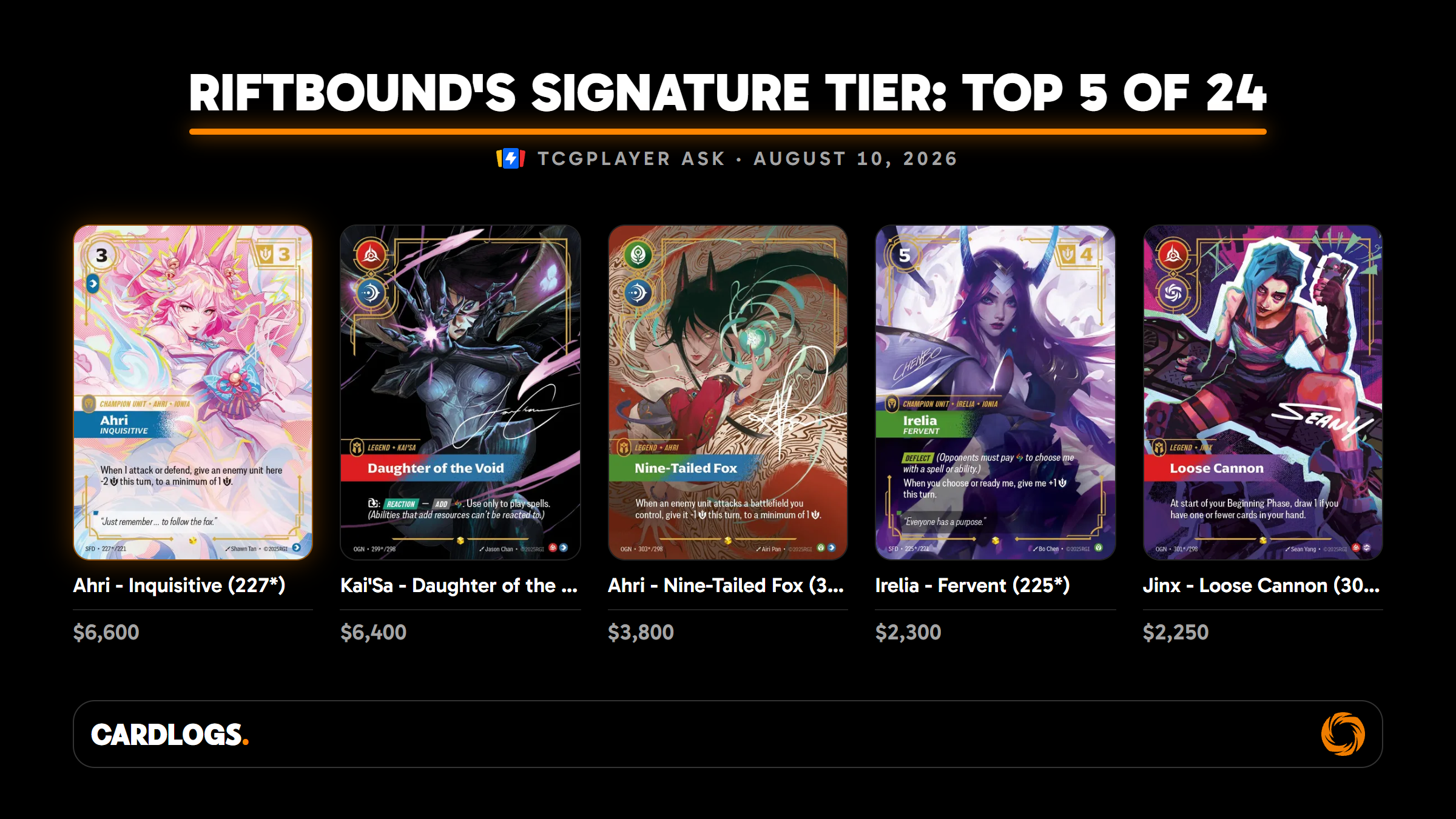
How does the rest of Riftbound's Signature tier compare now?
The pack-pulled Signature cards from Origins, Spiritforged and Vendetta were our reference class in August. Their signatures are the illustrators', not players'; the T1 cards are the first Riftbound cards signed by esports players.
| Rank | Card | # | Set | TCGplayer | eBay sold | Cardmarket (USD) |
|---|---|---|---|---|---|---|
| 1 | Ahri - Nine-Tailed Fox (Signature) | 303* | Origins | $3,624.82 | $2,650.00 | $3,578.70 |
| 2 | Ahri - Inquisitive (Signature) | 227* | Spiritforged | $3,297.87 | $6,500.00 | $4,616.72 |
| 3 | Akali, Rogue Assassin (Signature) | VEN-189* | Vendetta | $3,229.71 | — | $3,271.77 |
| 4 | Kai'Sa - Daughter of the Void (Signature) | 299* | Origins | $3,114.31 | $3,150.00 | $3,396.44 |
| 5 | Irelia - Fervent (Signature) | 225* | Spiritforged | $1,572.06 | $2,000.00 | $2,037.45 |
| 6 | Miss Fortune - Bounty Hunter (Signature) | 309* | Origins | $1,526.25 | $2,277.15 | $2,714.71 |
Ranked by TCGplayer price on the September 25, 2026 nightly; Cardmarket converted at that night's rate (1.1403).
Against August 16, the tier's median TCGplayer price fell from $1,152 to $865.14, while its median eBay sold price rose from $1,001 to $1,075 (23 cards with a sold comp on each date). The two moving in opposite directions is the tell that much of the TCGplayer drop is our September 13 rule change rather than the market. Two of the 33 Signature cards now price below $360 on TCGplayer: Karma - Channeler at $320.02 (eBay sold $505) and Renekton, Butcher of the Sands at $350.00.
According to Cardlogs, the cheapest signed T1 card (Oner's Xin Zhao, €950 listing) asks more than the median pack-pulled Signature card is priced at on Cardmarket ($790.63). The T1 cards entered the market above the tier they were compared with.
Is the scarcity real? What the population data says
GemRate now resolves 29 of the 33 pack-pulled Signature cards, up from 18 in August, so the totals are not comparable across editions. On the current set, 29 cards account for 10,362 graded copies — 7,621 PSA and 2,741 BGS — at a median of 257 PSA slabs per card (September 25, 2026). Ahri - Inquisitive leads with 555 PSA slabs.
No T1 card has a graded population in our data yet. With 2,025 signed copies per player per language, the T1 cards sit in the same order of magnitude as the pack-pulled tier. The difference is that Riot published its number.
Where this data comes from
Cardlogs aggregates prices nightly from TCGplayer, Cardmarket and eBay sold listings (via PriceCharting) across 1,539 tracked Riftbound cards, 1,471 of them with a live TCGplayer price, plus PSA and BGS population data from GemRate. All figures are the September 25, 2026 nightly unless dated otherwise.
The ten T1 cards and the sealed bundle are priced from Cardmarket only: TCGplayer lists the sealed bundle (read by hand on September 26) but no T1 single, and no T1 eBay sale has reached our data. Cardmarket's price is its trend figure; its "cheapest listing" is the lowest current ask in any condition. Where a price has not changed for 10 or more nights while listings sit well below it, we show both and rank on neither.
The pack-pulled Signature class is keyed on the card's own "(Signature)" / "Signed Showcase" name, not the * in its collector number: Riftbound prints 45 * cards and 33 are signed. On September 13, 2026 Cardlogs changed how it computes TCGplayer prices for thinly traded cards, which moved many Signature prices down that night; comparisons across that date say so.
The short version
Riot sold the T1 Signature Edition for $360 by drawing. In late September a sealed bundle asks at least €1,700 on Cardmarket and $2,999.99 on TCGplayer, the ten singles trade on Cardmarket, and Faker's signed Galio is the priciest card at a €3,300 floor. The print run is 10,125 per language across three languages, not English-only as we first wrote. Prices here are still thin, one-venue readings, and we will say so until a second venue records sales.
Track the T1 cards and the rest of the game on the Riftbound market on Cardlogs, with live TCGplayer, Cardmarket and eBay sold prices on web, iOS and Android. Related reading: the most expensive Riftbound cards, Riftbound graded populations, the Radiance set guide (Seraphine's home set) and Vendetta pull rates.
Frequently asked questions
How much is the Riftbound T1 Signature Edition bundle worth?
As of September 25, 2026 the cheapest sealed bundle on Cardmarket asks €1,700 (about $1,939), 5.4 times Riot's $360 price, and Cardmarket's own price for the product has ranged from €3,539 to €5,054 since September 4. On TCGplayer the cheapest of 7 listings asks $2,999.99, with no recorded sale. It is a thin, one-venue market for sales: treat any single figure as a listing, not a settled price.
What is in the Riftbound T1 Signature Edition?
Five T1 player cards (Doran's Ambessa, Faker's Galio, Gumayusi's Miss Fortune, Keria's Seraphine and Oner's Xin Zhao). One of the five is serialized 1 to 2025 and carries a gold-stamped player signature; which player it is comes at a 1:5 ratio. Every bundle has exactly one, per Riot's announcement.
How many T1 Signature Edition bundles exist?
10,125 per language, in English, Chinese and Korean, per Riot's announcement: 30,375 in total. That is 2,025 signed, serialized copies per player per language. The English version was sold by drawing on Riot's merch store at $360; the Chinese (¥2,025) and Korean (₩500,000) versions were sold in-region.
Which signed T1 card is the most expensive?
Faker's Galio, Indefatigable. Its cheapest Cardmarket listing was €3,300 (about $3,763) on September 25, 2026, against €950 for Oner's Xin Zhao, the cheapest signed card. The five unsigned cards list from €190 to €310.
Is there a cheaper T1 Riftbound product?
Riot announced a T1 Worlds Champion Player Bundle at $70: the same five champions with different art, plus sleeves, a deckbox, a binder and a metal die, available later in 2026 through a drawing on the Riot merch store. It carries no signatures.